decentralizing the smartphone — part i: ipod
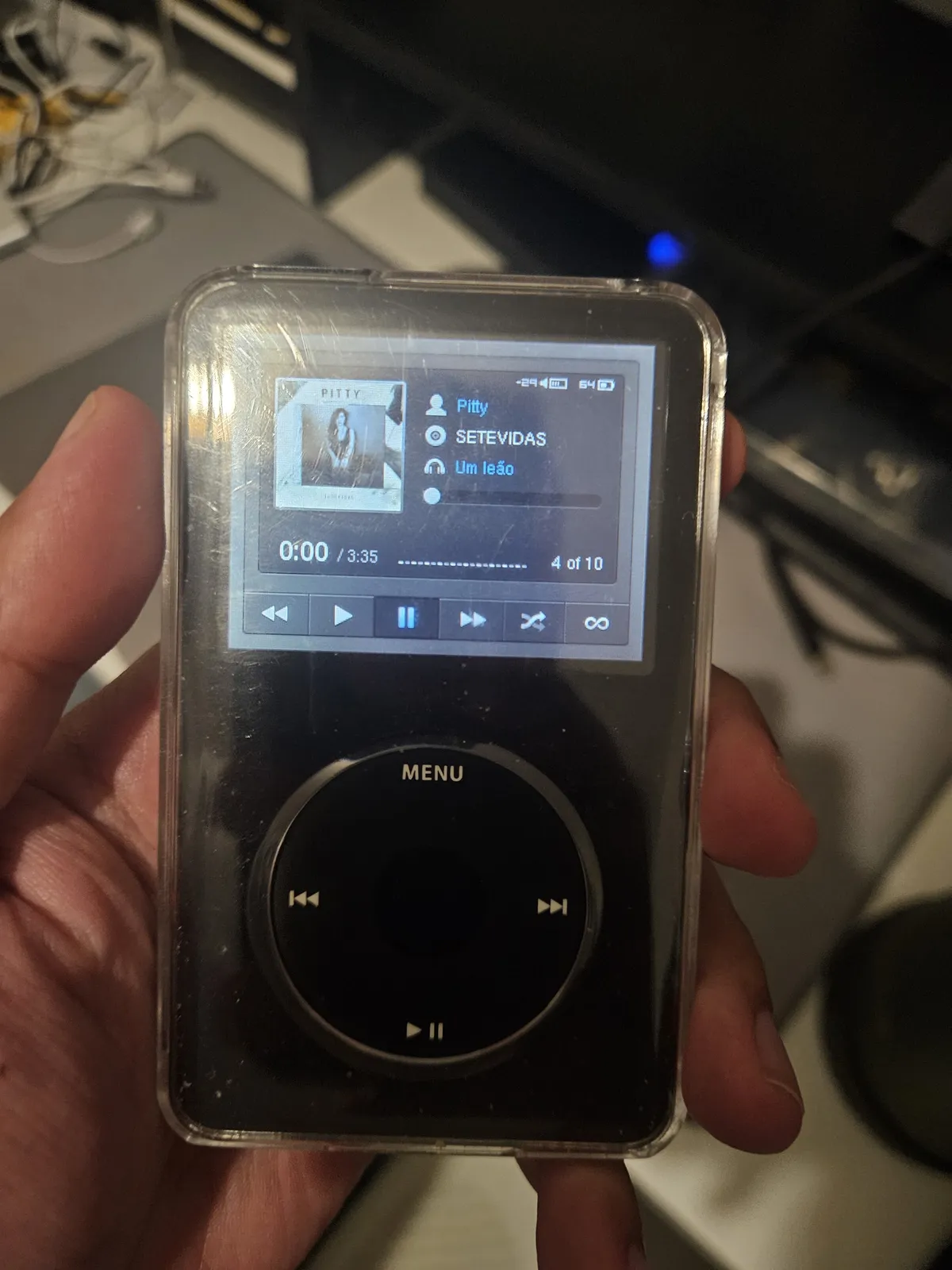
With the rise of streaming services, we gained access to millions of songs—but that abundance never brought proportional satisfaction. Quite the opposite: excess became paralysis. When everything is available all the time, nothing seems to carry weight. My alternative was to radically reduce my options and listen to music exclusively on a iPod Classic. On it, every album and every track has to be chosen manually, synced, organized. The storage limit forces selectivity. That limitation restores something streaming quietly dissolved: intention. Every song begins to occupy both physical and symbolic space; every choice carries consequence.
This practice exposes a larger problem: dependence on algorithms optimized for convenience and retention—not depth. Platforms compete for attention and turn time into the primary currency. Social networks and streaming services are designed to maximize engagement, offering constant, predictable, comfortable content—often shallow. The experience becomes passive: endless playlists, automatic recommendations, outsourced discovery.
By abandoning music streaming, listening became structured around complete albums again. The work recovers its internal narrative, its sequencing, its silence between tracks. Instead of consuming isolated songs in a continuous flow, there is immersion. The experience stops being fragmented and regains a beginning, middle, and end.
Using an iPod is part of a broader strategy: decentralizing the smartphone. Instead of concentrating every function into a single device—music, reading, communication, entertainment—the idea is to distribute tasks across dedicated devices. When music leaves the phone, the temptation to switch to notifications, social media, or messages disappears. Separating functions creates healthy friction and reduces compulsive use.
This is not about rejecting technology. It’s about redefining the relationship with it. Imposing limits, creating deliberate barriers, consciously deciding how and where attention is invested. Technology stops being an automatic stream and becomes a bounded tool.
There’s also the element of hackability. A dedicated device has to be interesting enough to compete with the smartphone. Instead of spending hours doomscrolling and numbing the mind, I spent hours trying to replace the original system with Rockbox. Time didn’t disappear into passive consumption; it was invested in experimentation, failure, iteration, and learning. The interaction became active.
In the end, this is not about nostalgia, nor a fetish for old technology. It’s about asking how much time is being handed over to devices operating according to someone else’s incentives. When your future self looks back, will it see conscious choices—or just a past shaped by Apple, Spotify, and the broader logic of Big Tech?